
Syllogistic Reasoning Frameworks (SR-FoT): Bring Logic Back to AI
TL;DR
Stop AI from making logical leaps that could cost your business. Syllogistic Reasoning frameworks force AI to connect dots properly - from starting facts to conclusions, with zero guesswork. Perfect for contracts, compliance checks, and any decision where "probably right" isn't good enough.
Who This Guide Is For & What You'll Achieve
- Irish business owners who need airtight reasoning for critical decisions
- Legal professionals reviewing contracts and agreements
- Compliance officers checking regulatory requirements
- Financial advisors validating investment logic
- Anyone tired of AI jumping to conclusions without proper reasoning
Outcomes you'll achieve:
- Force AI to show every logical step
- Catch faulty reasoning before it costs money
- Build bulletproof arguments for proposals
- Automate logical validation of decisions
- Create audit trails that actually make sense
Quick Chooser: Pick Your Logic Method
- Need watertight contracts? → Start with Premise Validation Framework
- Checking compliance? → Use Logical Bridge Method
- Building arguments? → Apply Classic Syllogistic Chain
- Finding contradictions? → Deploy Contradiction Detection
- Validating decisions? → Try Inference Validation Chain
- Complex reasoning? → Use Multi-Premise Reasoning
- Quality control? → Implement Logical Consistency Check
- Spotting assumptions? → Apply Assumption Surfacing
The Logic Error That Started It All
A property developer nearly lost a major deal when their AI-generated feasibility study contained this gem: "Since all prime locations have high footfall, and this building is expensive, it must be a prime location."
The AI had it backwards. The building was expensive because it was newly renovated - not because of its location in a struggling retail district. The flawed logic almost led to a disastrous investment.
This happens daily across businesses. AI makes logical leaps that sound reasonable but don't actually follow. In business, these leaps can mean lost deals, compliance violations, or strategic disasters.
Enter Syllogistic Reasoning - the 2,300-year-old logic system that's suddenly the hottest thing in AI prompting.
What Exactly Is Syllogistic Reasoning?
Think of it as forcing AI to think like a careful solicitor rather than an eager intern. Every conclusion must follow from clearly stated starting facts (logical "premises").
Here's the structure:
- Premise 1: A starting fact or rule
- Premise 2: Another starting fact or rule
- Conclusion: What MUST follow (not what might follow)
Classic Irish business example:
- Premise 1: If a business exceeds the current VAT registration threshold, it must register for VAT
- Premise 2: Our revenue exceeds the current threshold
- Conclusion: We must register for VAT
Simple? Yes. Powerful? Absolutely.
The magic happens when you force AI to work this way for complex business decisions. No more "it seems like" or "probably" - just rock-solid logical connections.
Core SR-FoT Methods That Actually Work
Method Card 1: Classic Syllogistic Chain
What it is:
Forces AI to build arguments using clear premise-to-conclusion chains. Each conclusion becomes a starting point for the next step.
When to use:
- Building business cases
- Justifying budget requests
- Creating proposals for Enterprise Ireland grants
- Explaining strategic decisions to stakeholders
Why it helps:
- Makes reasoning transparent
- Catches logical gaps instantly
- Creates persuasive arguments
- Builds trust with stakeholders
SMB Example Prompt:
Build a logical argument for expanding our Dublin delivery area using syllogistic chains:
Start with these facts:
- Current delivery radius: [X] km
- Delivery requests outside radius: [Y] per week
- Average order value outside radius: €[AOV]
- Current delivery capacity: [utilisation]% utilised
For each logical step:
1. State two clear starting facts (premises)
2. Draw one conclusion
3. Use that conclusion as a premise for the next step
4. Continue until you reach a business decision
Format:
STEP X:
Premise 1: [fact/rule]
Premise 2: [fact/rule]
Therefore: [conclusion]
Method Card 2: Premise Validation Framework
What it is:
Checks whether your starting assumptions are actually true before building conclusions on them.
When to use:
- Strategic planning
- Market analysis for Irish markets
- Risk assessment
- Investment decisions
Why it helps:
- Prevents building on false foundations
- Identifies hidden assumptions
- Reduces costly mistakes
- Improves decision quality
SMB Example Prompt:
Validate the logical starting points for our Cork expansion plan:
Claimed premises (starting assumptions):
1. "Cork market prefers premium products"
2. "Competitors can't match our quality"
3. "Demand will grow 20% annually"
For each premise:
- Mark as [VERIFIED] with source
- Mark as [ASSUMED] if unproven
- Mark as [FALSE] if contradicted
- Provide evidence or counter-evidence
- Rate confidence: 0-100%
Then show what conclusions are still valid.
Method Card 3: Logical Bridge Method
What it is:
Connects distant concepts through a series of logical steps, like building a bridge one span at a time.
When to use:
- Explaining complex relationships to Revenue
- Justifying non-obvious decisions
- Connecting strategy to tactics
- Building stakeholder buy-in
Why it helps:
- Makes complex reasoning followable
- Identifies missing links
- Builds stronger arguments
- Reduces confusion
SMB Example Prompt:
Build a logical bridge from "employee wellness programme"
to "increased profits":
Rules:
- Each step must logically follow from the previous
- No jumps or assumptions
- Each connection must be verifiable
- Maximum 7 steps
Format each step:
[A] leads to [B] because [logical reason]
Evidence: [data/research/Irish example]
Confidence: [percentage]
Method Card 4: Contradiction Detection
What it is:
Systematically finds logical conflicts in documents, plans, or decisions.
When to use:
- Contract reviews
- Policy checking for GDPR compliance
- Revenue compliance audits
- Quality control
Why it helps:
- Catches expensive mistakes early
- Ensures consistency
- Reduces legal risks
- Improves document quality
SMB Example Prompt:
Find logical contradictions in these business rules:
[Paste your policies/contracts/rules here]
For each contradiction found:
1. Quote the conflicting statements
2. Explain why they can't both be true
3. Show the logical conflict
4. Suggest resolution
5. Rate severity (LOW/MEDIUM/HIGH)
Format:
CONTRADICTION #X:
Statement A: [quote]
Statement B: [quote]
Logical conflict: [explanation]
Resolution: [suggestion]
Severity: [rating]
Method Card 5: Assumption Surfacing
What it is:
Reveals hidden assumptions that could derail your plans if wrong.
When to use:
- Business planning for the market
- Project proposals
- Budget forecasting
- Risk management
Why it helps:
- Exposes blind spots
- Reduces project failures
- Improves contingency planning
- Builds realistic expectations
SMB Example Prompt:
Surface hidden assumptions in this business plan:
[Paste plan summary or key points]
For each assumption found:
- State the hidden assumption clearly
- Mark as [CRITICAL] or [MINOR]
- Explain what depends on this assumption
- Describe what happens if it's false
- Suggest how to verify or protect against it
Priority order: Most critical first
Method Card 6: Inference Validation Chain
What it is:
Tests whether conclusions actually follow from the given information.
When to use:
- Reviewing recommendations
- Checking analysis reports
- Validating AI outputs
- Quality-checking decisions
Why it helps:
- Catches faulty reasoning
- Improves decision quality
- Builds logical rigour
- Reduces errors
SMB Example Prompt:
Validate these business inferences:
Inference 1: "Since sales dropped 15%, we should cut marketing spend"
Inference 2: "Customer complaints increased, so quality has decreased"
Inference 3: "Competitors lowered prices, therefore we must too"
For each inference:
1. List the stated premises (starting facts)
2. Check if conclusion MUST follow
3. Identify missing premises needed
4. Mark as VALID, INVALID, or INCOMPLETE
5. Provide correct logical reasoning
Include alternative valid conclusions.
Method Card 7: Multi-Premise Reasoning
What it is:
Handles complex decisions involving multiple interconnected facts and rules.
When to use:
- Strategic decisions
- Multi-factor analysis
- Complex problem-solving
- Regulatory compliance
Why it helps:
- Manages complexity systematically
- Prevents oversimplification
- Captures full picture
- Improves thoroughness
SMB Example Prompt:
Analyse this multi-factor decision using proper logic:
Decision: Should we launch Product X in Galway?
Starting facts:
- Development cost: €[amount]
- Market interest: [percentage]
- Competitor share: [estimate]
- Our capacity is [value]% utilised
- CE marking approval pending
- Customer acquisition cost: €[amount]
Build logical chains showing:
1. What conclusions follow from combining facts
2. Which facts conflict with others
3. What additional info is needed
4. Final logical recommendation
Show your reasoning tree visually if possible.
Method Card 8: Logical Consistency Check
What it is: Ensures all parts of a document, strategy, or system follow the same logical rules.
When to use:
- Policy development
- System documentation
- Process standardisation
- Brand messaging across markets
Why it helps:
- Ensures coherence
- Reduces confusion
- Improves professionalism
- Catches errors
SMB Example Prompt:
Check logical consistency across our customer service policies:
[Paste policies or key sections]
Examine:
1. Do all policies follow same logical structure?
2. Are if-then rules consistently applied?
3. Do exceptions follow logical patterns?
4. Are similar situations handled similarly?
Report:
- Inconsistency type and location
- Logical principle violated
- Impact on customers/staff
- Suggested fix
- Priority (1-5)
Summary: Overall consistency score /100
Industry-Specific Copy-and-Paste Templates
Using Data Responsibly - Micro‑Guideline
- Source every number. Record the document/report name, version, and origin (internal/external).
- Snapshot the context. Date/time of data capture and geography (Ireland / region / site).
- Method notes. How each figure was calculated (incl./excl. VAT, rounding, currency €), and any conversion factors.
- Status labels. Mark each figure as [MEASURED] or [ASSUMED] and keep assumptions separate from facts.
- Reg/standard versions. Note the version/date for thresholds and rules (VAT, RPZ, HSE, CBI, ISO, etc.).
- Confidence & ownership. Add a 0–100% confidence score and reviewer initials/date.
- No guessing. If unknown, leave the [placeholder] and come back - don’t invent numbers.
- Retention. Store the file/snippet in your repo or drive and link it in the notes.
Mini citation block you can paste under any template:
Data source: [Name, doc/version, link or path]
Snapshot: [YYYY‑MM‑DD] Geography: [IE/region]
Method: [calc/definition, incl./excl. VAT, units]
Assumptions: [list]
Owner/Reviewer: [initials/date] Confidence: [0–100%]
Retail: Pricing Logic Validator (Irish Market)
Validate our pricing logic for consistency:
Current pricing rules:
- Base price: €[X]
- Bulk discount: [Y]% for [Z]+ units
- Member discount: [A]%
- VAT: [current applicable rate for this product]
- Seasonal adjustment: +/-[B]%
Test scenarios:
- Member buying 50 units in December
- Non-member buying 5 units in July
- Member buying 1 unit in peak season
For each scenario:
- Show logical steps to final price (inc. VAT)
- Identify any rule conflicts
- Flag illogical outcomes
- Suggest improvements
Ensure no scenario produces negative margin.
Data Entry Notes (complete before use):
Sources & documents (price lists, promos): [ ]
Data snapshot date (DD-MMM-YYYY): [ ]
Baseline period (from–to): [ ]
VAT rate used & reason (product class): [ ]
Assumptions/estimates: [ ]
Reviewer & date: [ ]
Confidence (0–100%) & rationale: [ ]
Healthcare: Treatment Protocol Logic (HSE‑Aligned)
Check logical flow of our treatment pathway.
Condition: [specify]
Protocol: [key steps]
Guidelines: [HSE guidance reference]
For each decision point:
- If X then Y rule
- Outcomes covered?
- Contradictions?
- Patient-safety logic?
- Any circularity?
Mark [MISSING LOGIC], [CONTRADICTION], [RECOMMENDATION].
Data Entry Notes (complete before use):
HSE guideline/version & link: [ ]
Local clinical policy/version: [ ]
Evidence sources cited: [ ]
Effective dates / review cycle: [ ]
Clinical sign‑off (name/initials/date): [ ]
Confidence (0–100%) & rationale: [ ]
Professional Services: Proposal Argument Builder
Build the argument for this proposal.
Client need: [problem]
Our solution: [offering]
Investment: €[amount]
Syllogistic steps:
1) Need → Impact on operations
2) Impact → Required capabilities
3) Capabilities → Our solution
4) Our solution → Expected outcomes
5) Outcomes → ROI (show method, not claims)
State confidence per step.
Data Entry Notes (complete before use):
Client data source(s) & discovery notes: [ ]
ROI method & assumptions document: [ ]
Baseline metrics (period): [ ]
Dependencies/constraints recorded: [ ]
Reviewer & date: [ ]
Confidence (0–100%) & rationale: [ ]
Financial Services: Risk Assessment Logic (CBI‑Aligned)
Apply structured reasoning to this investment.
Type: [asset/product]
Amount: €[value]
Client profile: [per CBI guidance]
Market conditions: [current context]
Chains to build:
1) Suitability (profile → product match)
2) Risk drivers → Risk level
3) Conditions → Return scenarios
4) Recommendation (with caveats)
Flag [NEEDS REVIEW] and [ASSUMPTION].
Rate logical strength: WEAK/MODERATE/STRONG (justify).
Data Entry Notes (complete before use):
CBI client categorisation evidence: []
KYC/AML docs checked (IDs): [ ]
Product KID/PRIIPs or factsheet version: [ ]
Risk banding method reference: [ ]
Market data timestamp/source: [ ]
Reviewer (CF role) & date: [ ]
Confidence (0–100%) & rationale: [ ]
Legal Services: Contract Consistency Checker (Irish Law)
Check contract for logical consistency.
[Paste clauses]
Examine:
- Definition consistency
- If-then clause logic
- Exceptions handling
- Termination interactions
- Payment term logic (incl. Late Payment rules)
For each issue:
- Clause refs
- Nature of problem
- Potential impact
- Suggested revision
- Risk: LOW/MEDIUM/HIGH/CRITICAL
Data Entry Notes (complete before use):
- Jurisdiction & governing law confirmed: [ ]
- Statutes/codes versions cited: [ ]
- Cross‑refs/definitions map version: [ ]
- Counterparty doc version/date: [ ]
- Reviewer (solicitor) & date: [ ]
- Confidence (0–100%) & rationale: [ ]
Marketing Agency: Campaign Logic Validator
Validate campaign strategy logic.
Target audience: [Irish segment]
Message: [key points]
Channels: [media]
Budget: €[breakdown]
Expected outcomes: [metrics]
Test links:
Audience → Message
Message → Channels
Channels → Budget split
Budget → Outcomes
Flag [LOGIC GAP]. Score each link 1–10. Suggest fixes.
Data Entry Notes (complete before use):
- Audience source (CRM/GA4/panel) & date: [ ]
- Channel cost benchmarks (CPM/CPC) & source: [ ]
- Attribution model & lookback window: [ ]
- Target metrics baseline period: [ ]
- Reviewer & date: [ ]
- Confidence (0–100%) & rationale: [ ]
Real Estate: Investment Logic Analyser (Irish Property)
Analyse investment logic.
Property: [location, type, BER]
Purchase price: €[amount]
Stamp duty: €[amount]
Renovation: €[amount]
Strategy: [rent/resale]
RPZ: [status]
Build:
- Market conditions → Value drivers
- Location factors → Demand
- Total investment → Required return
- RPZ/regs → Rent ceilings
- All factors → Go / No-Go (with rationale)
Show calculations. Flag risky assumptions.
Data Entry Notes (complete before use):
- Stamp duty calc version/date: [ ]
- BER cert/ref & date: [ ]
- RPZ status check date & source: [ ]
- Comparable sales/lettings sources: [ ]
- Finance assumptions (rate/term/LTV): [ ]
- Reviewer & date: [ ]
- Confidence (0–100%) & rationale: [ ]
Manufacturing: Quality Decision Tree
Create a logic tree for quality issues.
Issue: [describe]
Severity indicators: [list]
Protocols: [extract]
Standards: [CE/ISO refs]
Flow:
Issue type → Investigation
Investigation → Root causes
Root cause → Corrective actions
Actions → Prevention
Prevention → Monitoring
Specify decision criteria at each node.
Data Entry Notes (complete before use):
- Applicable ISO/CE standard & clause: [ ]
- Batch/lot references & dates: [ ]
- NCR/CAPA IDs linked: [ ]
- Calibration/validation certs: [ ]
- Reviewer (QA) & date: [ ]
- Confidence (0–100%) & rationale: [ ]
Hospitality: Service Recovery Logic (Fáilte Ireland Standards)
Design a service recovery pathway.
Complaint: [category]
Impact: [severity]
Resources: [options]
Steps:
1) Impact assessment
2) Response tier selection
3) Compensation calculation (€) with rule
4) Follow-up requirements
5) Prevention logic
Include clear escalation triggers.
Data Entry Notes (complete before use):
- Fáilte Ireland guidance/version: [ ]
- Hotel/policy doc version: [ ]
- Compensation policy formula source: [ ]
- SLA/escalation thresholds: [ ]
- Reviewer & date: [ ]
- Confidence (0–100%) & rationale: [ ]
Your 4-Step Implementation Roadmap
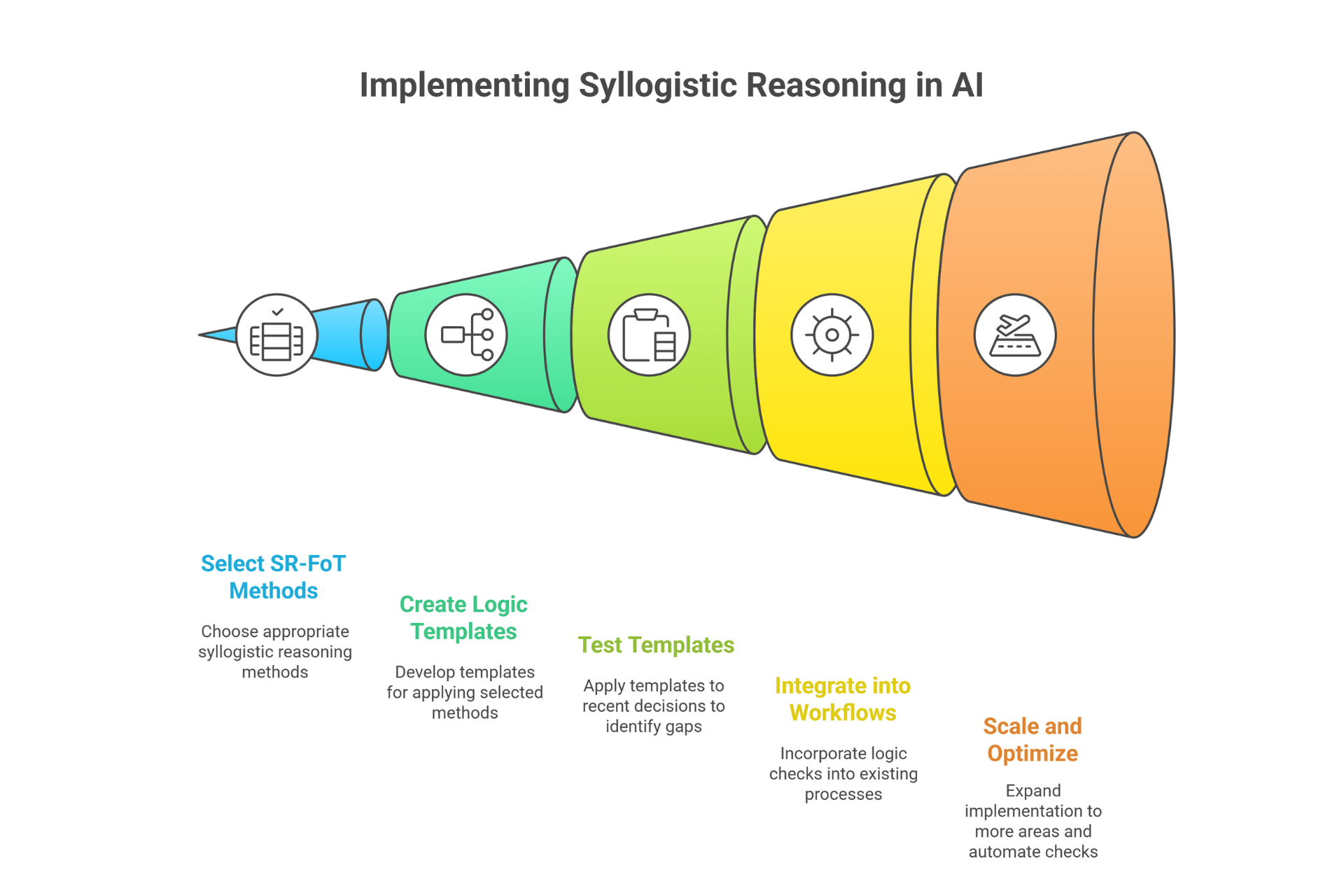
Week 1: Logic Foundation
- Choose your highest-risk decision area
- Select 2 SR-FoT methods to start
- Create first logic templates
- Test on recent decisions
- Document logical gaps found
Week 2: Validation Sprint
- Apply Premise Validation to current plans
- Run Contradiction Detection on key documents
- Surface assumptions in upcoming projects
- Calculate error reduction
- Adjust templates based on results
Week 3: Process Integration
- Add logic checks to approval workflows
- Create team logic templates
- Set up regular consistency audits
- Train key staff on methods
- Measure time savings
Week 4: Scale and Optimise
- Expand to 2 more business areas
- Combine multiple methods
- Automate routine logic checks
- Create logic quality metrics
- Plan wider rollout
Results & ROI (What to Measure - Plug in Your Own Data)
Track outcomes using your own baselines and actuals—don’t insert figures until measured.
Logic Quality
- Contradictions found per document
- % of conclusions with all starting facts stated
- Share of conclusions rated VALID vs INCOMPLETE vs INVALID
Decision Quality
- Proposal approval/win rate (before vs after SR‑FoT)
- Compliance issues flagged pre‑submission vs post‑submission
- Reversals/rollback rate on key decisions
Time & Cost
- Average review time per contract/proposal
- Number of rework cycles per document
- Value of prevented errors (use post‑mortem estimates)
Typical Timeline (indicative)
- Weeks 1–2: First gaps discovered and templates refined
- Month 1: Fewer logical errors in reviews
- Month 3+: Stable templates, partial automation and measurable savings
Common Pitfalls and How to Dodge Them
Pitfall 1: Over-Complicating Simple Decisions
Problem: Using 10-step logic chains for obvious choices
Solution: Reserve SR-FoT for decisions over €1,000 or compliance issues
Quick test: If you can explain it in one sentence, skip the framework
Pitfall 2: Missing Hidden Premises
Problem: Logic seems sound but conclusion still wrong
Solution: Always run Assumption Surfacing first
Example: "All customers want lower prices" (hidden: "if quality stays same")
Pitfall 3: Forcing Binary Logic on Grey Areas
Problem: Real world doesn't always follow strict logic
Solution: Include confidence percentages and ranges
Better approach: "70% likely true given current data"
Pitfall 4: Logic Without Context
Problem: Technically correct but practically useless
Solution: Add Irish business context to every logical chain
Remember: Right logic + wrong context = wrong decision
Pitfall 5: Confusing Logical Premises with Physical Premises
Problem: Mixing up logical starting points with buildings/property
Solution: Use "starting facts" or "assumptions" when clarity neede
FAQ: Your Logic Questions Answered
Do I need special AI tools for syllogistic reasoning?
No, these methods work with any AI that accepts detailed prompts. ChatGPT, Claude, even basic models can handle syllogistic reasoning. The power is in how you structure the prompt, not the AI you use. Start with what you have.
Won't this slow down decision-making?
Initially, yes - a short overhead per decision. But you'll save time by avoiding rework. Many teams see net time savings after a short bedding‑in period. Major decisions deserve a few minutes of disciplined reasoning.
Can I automate these logic checks?
Absolutely. Once you've created templates, you can automate routine checks. Set up weekly contradiction scans, automatic premise validation for proposals, or triggered logic audits for contracts over certain values. Start manual, then automate what works.
How do I know which method to use when?
Start with this simple rule:
Use Premise Validation for planning, Contradiction Detection for reviewing, Classic Syllogistic Chain for persuading, and Assumption Surfacing for risk management. After a month, you'll instinctively know which fits each situation.
Recent Posts